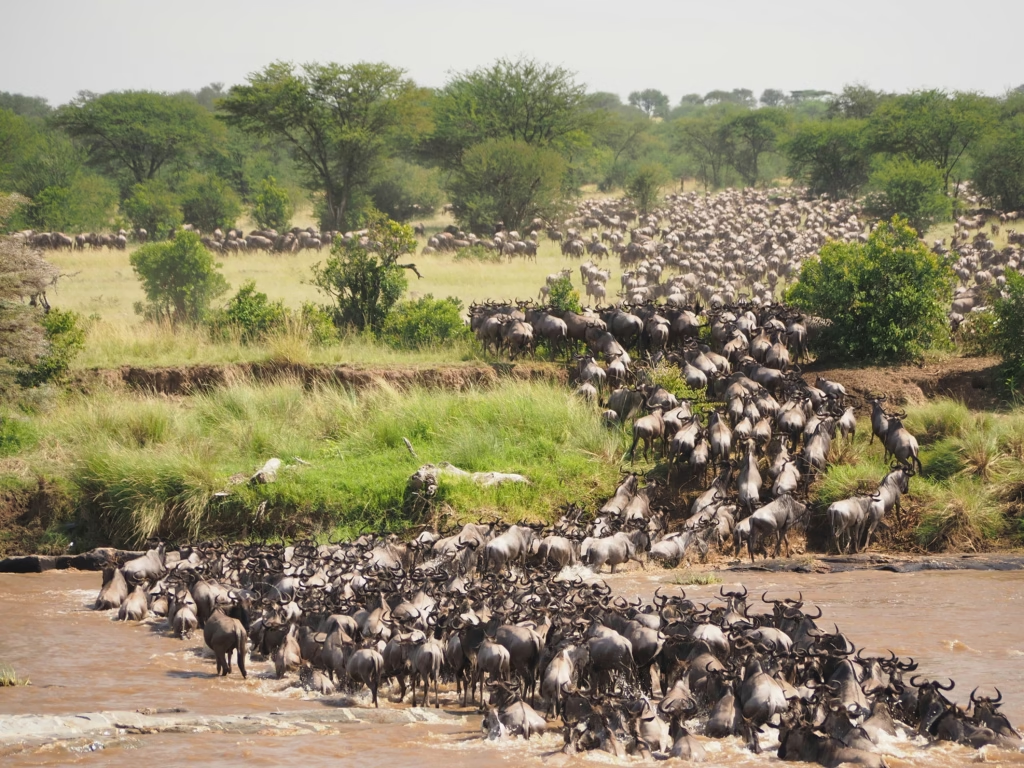
Late July, August, September and early October are the months most people picture when they imagine the Great Migration: the herds pushed into the northern Serengeti, gathered in their thousands on the banks of the Mara River, working up to the chaotic plunge across it. Pairing this with gorilla trekking gives you the two single most iconic wildlife moments in East Africa on one trip, but it’s also the combination that needs the most advance planning: this is peak season for both experiences at once, and neither books last-minute.
What to Expect During Peak Crossing Season
By July, the migration’s leading edge reaches the northern Serengeti and the Mara River; August is generally considered the single most reliable month for witnessing a crossing, with September remaining strong and adding excellent predator sightings on the surrounding grasslands as the herds concentrate in the area. Crossings themselves are never scheduled, herds can mill at the riverbank for hours before committing, or turn back entirely and try again later, so patience and time in the area matter more than any single game drive. Camps positioned directly along the river (including several on the Tanzania side, which let you watch the same crossings without needing to cross into Kenya) put you closest to the action without long daily transfers.
This is also, unavoidably, the busiest and most expensive season in the region, both for Serengeti camps and for gorilla permits, so availability both run higher than any other combination in East Africa.
How to Move Between Gorilla Trekking and the Mara River Crossings
Because the action is concentrated in the northern Serengeti during these months, this is the most straightforward of the seasonal combinations to route, logistically, northern Serengeti camps sit closer to Kilimanjaro and to direct flight connections than Ndutu or the western corridor do.
If starting with gorillas: fly into Kigali, trek in Rwanda’s Volcanoes National Park ($1500 per person) or proceed to Uganda’s Bwindi Impenetrable National Park ($800 per person), then fly to Kilimanjaro and connect to the northern Serengeti either by road (longer) or a scheduled flight into the Kogatende airstrip, which sit close to the main crossing points.
If starting with Serengeti: fly into Kilimanjaro, base yourself in the northern Serengeti for the crossings, then fly to Kigali or Entebbe to close the trip with gorilla trekking.
The direct RwandAir Kigali to Kilimanjaro flight or Uganda Airlines Entebbe to Kilimanjaro (about 1 hour 45 minutes) run multiple times weekly to make the connection between Tanzania, Uganda and Kigali convenient.
How Many Days to Plan
10 to 14 days for a properly paced trip: 3 to 4 days for gorillas, a transfer day, and 3 to 4 days in the northern Serengeti, and 3 to 4 for other parks in Tanzania. Crossings are unpredictable, so more days in the area meaningfully improve your odds of witnessing one rather than a single rushed morning at the riverbank.
A Sample 2 Weeks Uganda Primates and Great Migration Safari Itinerary for the months of August and September.
Days 1–3: Kibale Forest, Uganda
Arrival at Entebbe, transfer to Kibale (about 6 hours by road, or a shorter flight via Kasese), settle in, then a morning of chimpanzee tracking.
Days 4–6: Bwindi Impenetrable National Park, Uganda
Transfer south to Bwindi, a rest day to settle in before trekking or after trekking, then your gorilla trekking day.
Day 7: Transfer to Kigali, Rwanda
Cross the border via Cyanika into Rwanda and continue to Kigali, ready for the onward flight.
Day 8: Fly to Kilimanjaro, Transfer Toward the Serengeti
The direct flight (about 1 hour 45 minutes) connects Kigali to Kilimanjaro. Transfer to Arusha to connect with a bush flight the following morning.
Day 9: Bush Flight From Arusha to the Northern Serengeti
A scheduled light-aircraft flight from Arusha into an airstrip serving the northern Serengeti- Kogatende airstrip positioning you close to the Mara River crossing points without a long daily drive to reach them.
Days 9–11: Northern Serengeti and the Mara River (3 Nights)
Full days centered on the crossing points, with time built in for the unpredictability of the crossings themselves, some visitors see multiple crossings in a stay this length, others wait out a quieter day before one happens.
Day 12: Ngorongoro Crater (1 Night)
A longer transfer than the calving-season version of this route, since the northern Serengeti sits well south of Ngorongoro. A full day on the crater floor follows, among the densest wildlife concentrations in Africa.
Day 13: Tarangire National Park (1 Night)
On to Tarangire, known for its elephant herds and baobab-dotted landscape, a strong closing contrast to both the crater and the open Serengeti plains.
Day 14: Departure
Transfer to Kilimanjaro airport for your flight home.